
Photo credit: Flickr
The fight over the replacement for Supreme Court Justice Anthony Kennedy may decide the future of women’s rights in America but a silent war for equality has been fought for over forty years and that fight may soon be won. If we really want to protect women’s reproductive rights, if we really want to ensure equal pay for equal work, if we truly want to end gender discrimination, we simply cannot entrust the courts to continuously interpret the Equal Protection Clause of the 14th Amendment as applying to women. While it may seem outrageous to pragmatic, logical minded people, constitutional fundamentalists including the late Supreme Court Justice and conservative hero, Antonin Scalia interpret the 14th Amendment as it was interpreted when it was written in the late 1800s, an interpretation which holds that women are not legally “persons” and thus not protected under the amendment. While this radical opinion is not widely held, beliefs that the 14th Amendment does not fully prohibit sex discrimination are fairly widespread. These opinions, when held by judges, can hamper reproductive freedom by allowing draconian restrictions on abortion and contraception. In addition, the 14th Amendment alone does not fully prevent wage discrimination. The rights of the LGBTQ community are also at risk when there is ambiguity on the legality of sex discrimination.
The only way to truly protect our society from sex-based discrimination is the passage of a constitutional amendment known as the Equal Rights Amendment or ERA. The main section of the amendment reads as follows: “Equality of rights under the law shall not be denied or abridged by the United States or by any State on account of sex.” The ERA would make it nearly impossible for insurance providers to deny women access to contraception under the guise of religious beliefs. Abortion rights would be significantly more protected under this amendment. Discriminatory, anti-transgender “bathroom bills” would also likely be struck down as a result of the ERA if it is ratified. Enforcement against discriminatory wage practices would likely be much stronger under the Equal Rights Amendment that it is now.
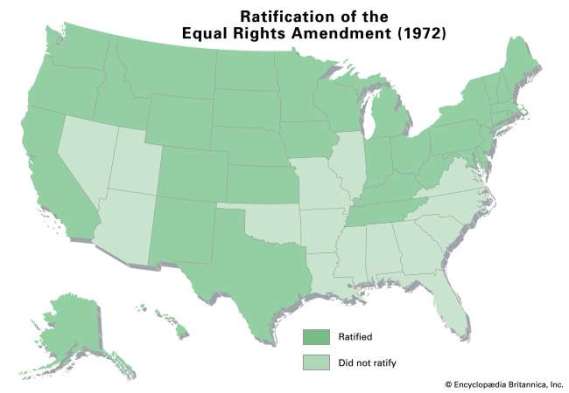
A map of states which have and have not ratified the ERA. Credit: Encyclopedia Britannica
While to many, the ratification of a constitutional amendment in the current political climate may seem like a distant pipe dream, in the case of the ERA, that could not be further from the truth. The most common path for the ratification of an amendment to the US Constitution is laid out in Article V of the document. In this path, amendments must pass a resolution with a two-thirds majority in both houses of Congress before being approved by the legislatures of three-fourths of the states. Currently, this means a total of 38 states must have approved any amendment for full ratification. The ERA passed Congress in 1978 and was ratified by 35 states before the 1985 deadline set by Congress. Since then, two more states have ratified the ERA. That’s right, if one more state approves the Equal Rights Amendment, then it will become part of the Constitution (well sort of). If another state ratifies the Equal Rights Amendment, many legal scholars claim that Congress could vote to extend the deadline for ratification, citing the 27th Amendment which was originally introduced in 1789 and finally ratified in 1992. If Virginia or any other state ratified the ERA, there would likely be a fierce legal battle over the specifics of the ratification process. The states yet to approve the ERA are listed below. If you live in one of these states, call or write your state legislators and tell them to support the Equal Rights Amendment to the Constitution. Also, wherever you live, if you are eligible to vote, make sure you are registered to vote and be certain to vote up and down the ballot on November 6th.
- Alabama
- Arizona
- Arkansas
- Florida
- Georgia
- Louisiana
- Mississippi
- North Carolina
- Oklahoma
- South Carolina
- Virginia
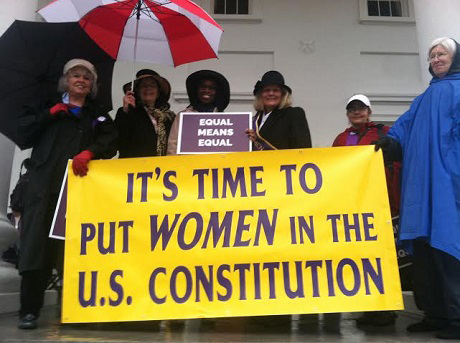
Demonstrators in Virginia pushing for the ratification of the ERA. Photo Credit: equalrightsamendment.org
 Youth News Journal