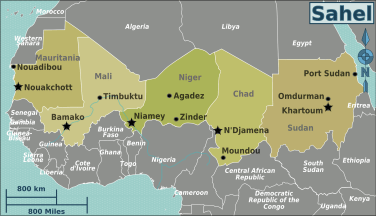
A map of the Sahel countries in North Africa. (Wikimedia Commons)
The Sahel has a large American and European military presence but is seldom covered in American news media. When the region is in the news, it is often due to militant groups like Boko Haram committing horrific acts of terror. More recently, the Sahel and Niger, in particular, were in the news due to the deaths of four American Army Rangers. The Sahel is the region of Africa on the southern edge of the Sahara desert, comprising of the countries of Sudan, Chad, Niger, Mali, Mauritania, and Burkina Faso as well as the northern part of Nigeria. This article focuses on events in Chad, Niger, Mali, Nigeria, and regions of Algeria and Libya which border Sahel countries.
Many countries in the Sahel have faced instability since they gained independence from British and French colonial rule in the 1960s. Much of this can be attributed to colonial powers drawing borders without regard for ethnic and religious divisions. As a result, several countries in the Sahel have faced ethnic strife which has bred civil war. The Sahel also lags far behind the rest of the world in most measures of human development. Mali, Chad, and Niger along with Northern Nigeria and Burkina Faso are some of the worst countries in the world in terms of literacy rate, infant mortality, and access to basic services. Unstable governments and widespread corruption have also plagued the Sahel and most countries have had one or more coup d’etats since independence.
Low levels of education, poverty, ethnic and religious strife, and weak governance all have contributed to a significant presence of several militant Islamic extremist groups including Al Qaeda in the Islamic Maghreb, Boko Haram, and affiliates of ISIS. Islamist insurgencies have existed in the Sahel since the Algerian Civil War of the 1990s however these groups really began to grow in prominence after the 9-11 attacks. In 2002, the Algerian Civil War ended but the Islamist insurgent groups continued to fight with the goal of establishing an Islamic state in Algeria. An organization known as the Armed Islamic Group in Algeria or GIA had fought in the Algerian Civil War and became an insurgent group based in the remote deserts of southern Algeria close to the border with Mali and Niger. For several years afterward, the GIA committed small-scale terror attacks on civilian and military targets and kidnapped citizens of western countries. Countries around the region began using military forces to combat jihadists in the desert regions bordering Algeria in Mali, Niger, and Mauritania. The regional coalition fighting against the GIA had backing from the United States, the UK and several European Union countries including France. In 2006 and 2007, the coalition was successful in forcing the militants to disperse into the Sahara Desert.
In order to compensate for their loss of territory and fighters, the GIA allied itself with Al Qaeda in 2006 and renamed itself Al Qaeda in the Islamic Maghreb or AQIM. AQIM also allied itself with another small radical Islamic fundamentalist group in Nigeria, Boko Haram. Under its new name, AQIM continued attacks against civilians in Algeria, Mali, and Niger until everything changed in 2011.
In the 2011 Arab Spring revolutions, the dictatorship in Libya was overthrown and the country descended into chaos. Groups aligned with Al Qaeda and other radical jihadist groups including AQIM began seizing territory in Libya. Chaos in Libya spilled over into neighboring countries. At the same time, ethnic tensions in Mali and Niger came to a head when the nomadic Tuareg ethnic group declared an independent state in the deserts of northern Mali and Niger and in southern Libya and began an armed rebellion against the governments of these countries. To add to the chaos, there was a military coup in Mali in 2012 which is largely blamed on the army’s discontent with the government’s handling of the situation in the north of the country. In the same year, AQIM and other Islamist militant organizations including Ansar Al-Sharia infiltrated the Tuareg rebellion and took over a vast portion of Mali including the important cities of Gao and Timbuktu. In 2013, a coalition of regional and French-led NATO troops began fighting in support of the Malian army in response to international attention to the situation there. A regional coalition also formed with the intention of restoring stability to Mali. That coalition was led by Chad and included several Sahel countries of Niger, Burkina Faso, Nigeria, and Mauritania. The NATO coalition led by France mainly included European countries such as Germany and Sweden, however, the United States played a large supporting role in training regional forces and airdropping supplies for coalition troops. Finally, in 2014, Malian and coalition forces were able to push Al Qaeda out of most of the towns in Northern Mali and the Malian government signed a peace agreement with the Tuareg rebels.
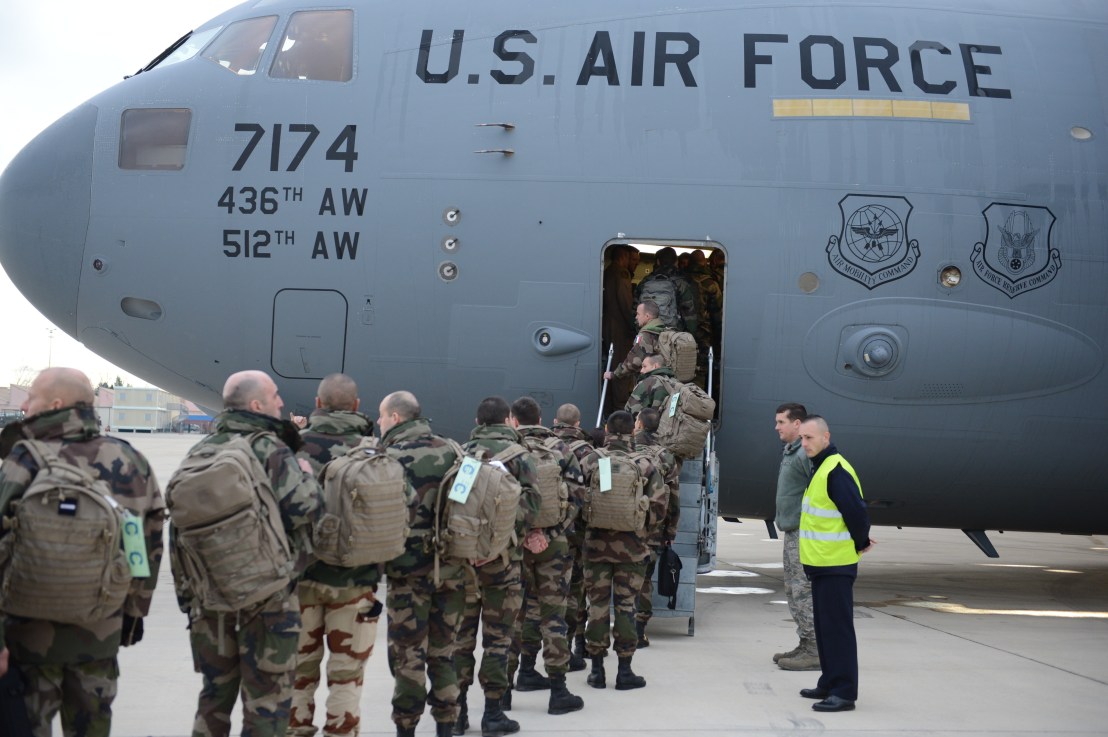
French soldiers boarding a US Air Force plane in Mali. (Wikimedia Commons)
While the full-scale war in Mali was resolved in 2014 and 2015, many Al Qaeda fighters stayed in the region. Some AQIM affiliates went back to committing kidnappings and small-scale terrorist attacks while others began working with other extremist groups in the Sahel, including the budding militant group in Nigeria, Boko Haram.
In Nigeria, an Islamic extremist militant group known as Boko Haram existed since 2002, however, violence really escalated after 2009. Boko Haram’s name roughly translates to “Western Education is Forbidden”. Nigeria’s population is almost equally split between the Christian south and a Muslim northern region. While the south of Nigeria has enjoyed economic growth since independence from the UK, the north has been slow to catch up and faces many problems common in the Sahel including drought, food shortages, illiteracy, and ethnic strife. Boko Haram used discontent among Muslim Nigerians to sow divisions and encourage people to join their ranks and commit acts of terror and violence against what the group considers “western influences”. Boko Haram also collaborated with other violent jihadist groups in the region and around the world. Many of Boko Haram’s leaders fought with AQIM in Mali. Boko Haram also has pledged allegiance to ISIS. Boko Haram’s tactics include using children as suicide bombers and committing massacres of civilians. The group gained international notoriety in 2014 after kidnapping hundreds of schoolgirls in northern Nigeria. Since then, Boko Haram has become the most deadly terrorist group in the world in terms of the number of people the group has killed.
Boko Haram’s influence spread into countries neighboring Nigeria including Niger, Chad, and Cameroon as the organization’s campaign of violence continued. These countries, supported by the United States have since been able to force Boko Haram and other extremist groups into hiding in remote areas of Northern Nigeria. Insurgent groups with ties to Al Qaeda and Boko Haram, still operate in remote areas of several Sahel countries.

Soldiers in Niger being trained by American special forces. (Wikimedia Commons)
While US involvement in the Sahel has helped several countries overcome terrorist threats, it has severe consequences for the region. Many civilians in Sahel countries see the presence of American troops as a breach of their country’s’ sovereignty. Many of the governments supported by the US are also dictatorships with bad human rights records. Supporting these governments contributes to short-term stability but often overlooks problems of repression that come to a head when people who are discontented with autocratic regimes see insurgent groups as alternatives. While Western countries have invested in some development in the Sahel, most of the American presence in the region is a military presence. Improved security often doesn’t last in areas with almost no economic growth and widespread corruption. Ethnic and religious divisions have also caused conflicts to spring up even after peace agreements have been reached. Western involvement in the Sahel may help countries solve security issues but the underlying issues which cause many of the Sahel’s conflicts remain and will likely take decades to solve.
 Youth News Journal